Voice support in India has a shape most vendor demos ignore. A customer calls and speaks Tamil. Or Hindi with English technical terms. Or Telugu that switches to English mid-sentence because there's no natural Telugu word for EMI bounce. Your IVR offers three languages, none of which is quite what they're speaking, and they mash zero until a human picks up.
That human may not speak their language either. So the call gets transferred, the customer repeats everything, and a two-minute query becomes eleven minutes across three people.
Voice agents can genuinely fix this. But the version that works is not the one being sold, and the difference matters enough that getting it wrong wastes a year.
Triage, not replacement
The pitch is usually full resolution: the AI handles the call end to end, no humans needed.
For Indian multilingual support, at current quality, that fails in a specific and damaging way. Code-switching, regional accents, background noise, and domain-specific terms compound. A system that's 90% accurate per turn is roughly 60% accurate across a five-turn conversation. The 40% get a frustrating experience and still reach a human, angrier, and now distrustful of the channel.
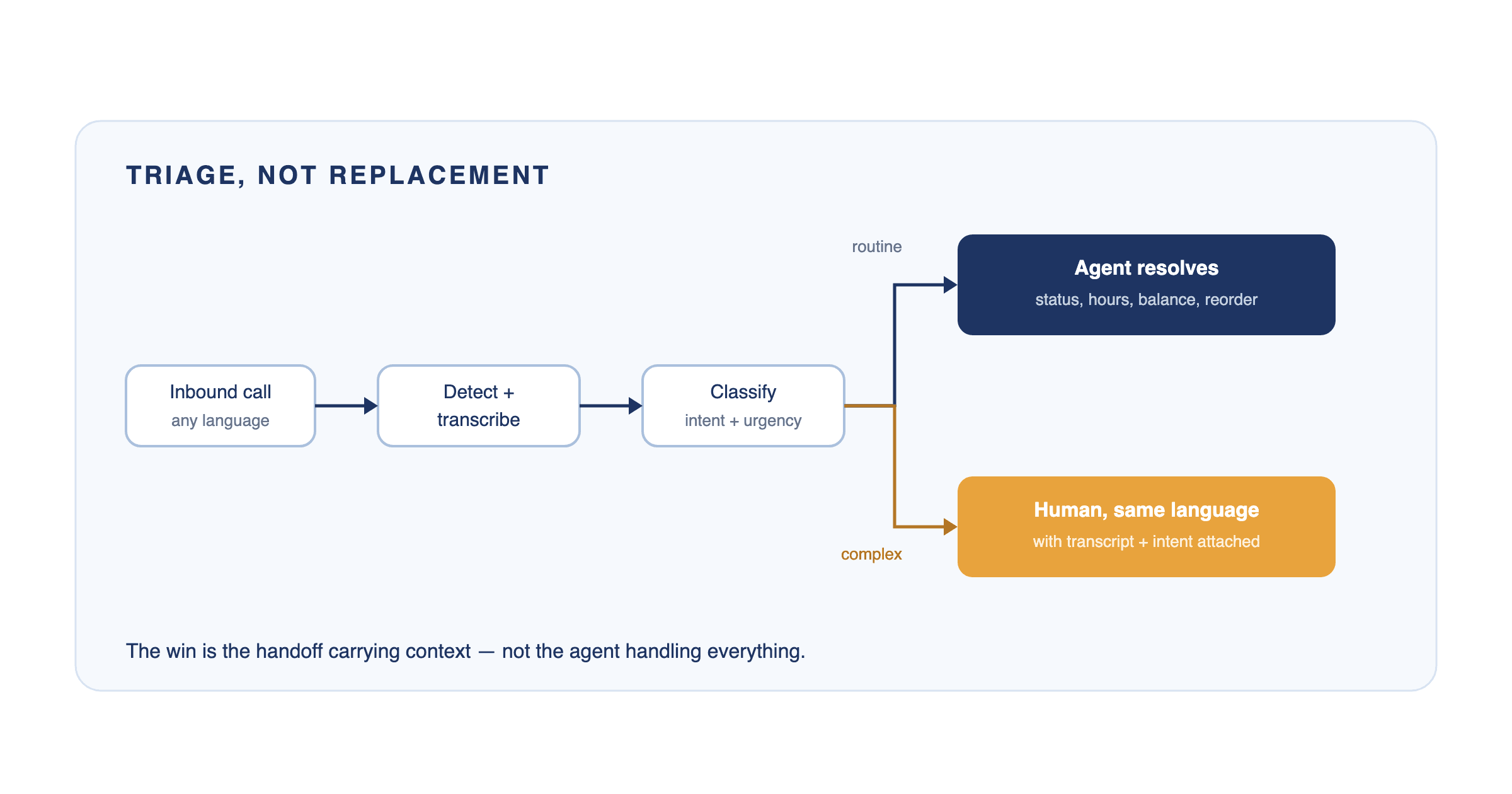
The version that works does four things and stops:
- Detects the language, including mid-sentence switching
- Transcribes the caller's actual problem
- Classifies intent and urgency
- Routes, resolving genuinely routine requests, and handing everything else to a human who speaks that language, with the transcript and intent already attached
The value is concentrated in step four. Not in the agent handling calls, but in the human receiving a call that's already understood, already in the right queue, already summarised. The customer stops repeating themselves. Average handling time drops without anyone being replaced.
That reframing changes what you build, what you measure, and whether it survives.
What the agent should resolve on its own
A narrow, deliberately boring list, high volume, low stakes, fully verifiable from a system of record:
- Order or delivery status
- Account balance, due date, last payment
- Branch hours, address, holiday schedule
- Simple reorders or repeat bookings
- Appointment confirmation and rescheduling
- Sending a document or link by SMS or WhatsApp
Shared traits: one lookup, no judgement, and being wrong is cheap and instantly obvious to the caller.
Everything else, complaints, disputes, anything about money moving, anything where an unhappy customer is on the line, goes to a person. Not because the model can't string a reply together, but because the cost of being wrong is asymmetric. A wrong delivery date is an annoyance. A wrong answer about a loan foreclosure charge is a complaint to the ombudsman.
The parts that are genuinely hard in India
Code-switching. People don't speak one language per call. Sir, mera payment fail ho gaya, but amount debit ho gaya hai. Systems that detect one language per call and lock to it mishandle this constantly. You need per-utterance detection, and a transcription model that tolerates mixed vocabulary rather than forcing everything into one script.
Accent variation within a language. Tamil in Chennai and Tamil in Madurai differ enough to move transcription accuracy several points. Vendor benchmarks are almost always run on clean, urban, read speech. Your callers are on a bike, near a generator, on a two-bar connection. Always evaluate on your own recorded calls, never on a vendor's demo set.
Domain vocabulary. Your product names, scheme names, and local branch names are not in any general model's vocabulary. These need a custom vocabulary or biasing list, and it makes a larger difference than choosing between providers.
Latency. Voice is unforgiving. Anything past roughly a second of silence and people start talking over the agent. This constrains your architecture more than accuracy does, a slightly less accurate model that answers fast often beats a better one that pauses.
Numbers. Account numbers, amounts, dates, OTPs. Transcription errors concentrate here, and this is exactly where errors are expensive. Always confirm digits back to the caller, and never let a voice agent act on a spoken number without explicit confirmation.
Design rules that decide whether people tolerate it
Say what it is. I'm an automated assistant, I can help with order status and account details, or connect you to our team. Callers who know they're talking to a machine adjust how they speak and are far more forgiving. Pretending otherwise breaks trust the moment it's obvious.
Always offer the exit. Saying agent or pressing zero must reach a human at any point. A voice agent with no escape hatch generates complaints regardless of quality, and in regulated sectors, it's a compliance problem.
Escalate on the second failure, not the fifth. If the agent hasn't understood twice, transfer. Every extra attempt costs more goodwill than the deflection is worth.
Escalate on frustration, not just on words. Raised voice, interruptions and repetition are all signals. Treat them as a transfer trigger.
Never make the customer repeat. The transfer must carry the transcript, detected language, classified intent, and account context to the human's screen. If your agent can't do this, you've built an obstacle rather than a triage layer.
Confirm before acting. Any action beyond a read gets read back and confirmed.
Compliance, which is not optional
Recording consent. Announce recording at the start, in the caller's language once detected.
DPDP obligations. Call recordings and transcripts are personal data, often sensitive. Purpose limitation, retention limits, and access controls apply. Decide retention before you build, not after.
Where audio is processed. Some providers process outside India. For regulated sectors that may be unacceptable. Ask, get it in writing, and check whether an India region is available.
Redaction. Card numbers, Aadhaar, OTPs spoken aloud land in transcripts and logs. Redact at ingestion, not later. Assume anything spoken will end up in a log unless you actively prevent it.
Sector rules. Financial services, insurance and healthcare have specific requirements about automated interaction and disclosure. Check with your compliance team before building, not after piloting.
What to measure
Deflection rate is the vanity metric. These matter:
Containment on the intended set. Of calls the agent was designed to handle, how many completed without transfer? Measured against its actual scope, not all calls.
Transfer quality. Of transferred calls, how often did the human have to ask the customer to repeat? This is the core value; if it's high, the handoff is broken.
Handling time on transferred calls, versus baseline. The clearest ROI figure, and the one that justifies the project.
Per-language accuracy. Aggregate accuracy hides that Tamil works and Kannada doesn't. Break it out and you'll find one language dragging everything down.
Repeat call rate. If people call back within 24 hours, the agent closed the call without solving the problem.
Zero-press rate. How many opt out immediately? Rising means people have learned it doesn't help.
A build order that doesn't waste a year
1. Listen first. Pull 200 real recorded calls. Categorise by language, intent and complexity. This tells you which two languages cover most volume and which five intents cover most calls. Almost always more concentrated than expected.
2. Benchmark transcription on those recordings. Your calls, your noise, your vocabulary. Compare providers on your data.
3. Build triage only. Detect, transcribe, classify, route. No resolution at all. Just make transfers smarter. This alone often justifies the project and carries almost no risk.
4. Add resolution for two intents. The highest-volume, lowest-stakes ones. Measure containment and repeat-call rate.
5. Widen one intent at a time, only where the numbers hold.
Most value arrives at step three. Many businesses should stop there for a year and be right to.
Where it doesn't pay
- Low call volume. Under a few hundred calls a month, a well-trained person is cheaper and better.
- Complex consultative calls. If most calls are advice rather than lookups, triage adds little.
- No system of record. If order status lives in someone's head or a spreadsheet, the agent has nothing to query. Fix that first.
- One dominant language and a team that speaks it. The multilingual advantage is the point; without it, the case is much weaker.
The honest summary
For Indian multilingual support, the voice agent worth building is a triage layer: it understands the caller, works out what they need, resolves the genuinely routine, and hands everything else to a human with full context.
That version is buildable now, measurable, degrades gracefully, and doesn't require the model to be right every time. Full autonomous resolution across 22 languages and a hundred intents is a demo, and demos don't survive a Thursday afternoon call queue.
The human-in-the-loop pattern is the same architecture applied to voice, and the four filters will tell you quickly whether your call profile justifies any of this.
Handling support calls in more than one language?
We build voice triage and support agents for Indian businesses, language detection, transcription tuned on your own recordings, intent classification, and handoffs that carry context to your team. Including the honest assessment of whether your call volume justifies it.
Bengaluru-based, working with clients across India and globally.
Get in touch · See our agentic AI work · WhatsApp: +91 9677749648