There's a pattern to AI deployments that survive their first year, and it isn't the one in the pitch decks.
The pitch is full autonomy: work goes in, results come out, nobody touches it. The systems that actually run in production for years look different. They handle the confident majority automatically and route everything uncertain to a person, and they're designed around that split from the beginning rather than retrofitting it after an incident.
This isn't a compromise or a stepping stone to real automation. For most business processes it's the correct terminal architecture.
Why full autonomy fails, specifically
AI systems are wrong at some rate. That's not a defect to be engineered away, it's what probabilistic systems do. A strong system on a narrow task might be wrong 2% of the time.
Two percent sounds fine. Consider what it means at 10,000 documents a month: 200 wrong results, every month, forever. Whether that's acceptable depends entirely on what happens to them.
And here's the part that makes full autonomy genuinely dangerous rather than merely imperfect: the errors aren't random. They cluster on unusual inputs, the new vendor's odd invoice format, the regional language edge case, the scanned document at a slight angle. Precisely the cases that are unusual are the cases the model handles worst, and unusual cases are disproportionately the ones that matter.
Worse, modern models fail fluently. A wrong extraction looks exactly like a right one. There's no ragged edge signalling this one is suspect. A system that silently produces confident wrong answers at 2% is far more dangerous than one wrong 10% of the time in obvious ways, because nothing triggers scrutiny.
The insight that makes everything work: models can often tell you when they're unsure. Not perfectly, but well enough to sort work into confident and uncertain far better than chance. If uncertainty is a signal you can act on, you don't need the model to be right every time. You need it to be right when it's confident, and honest when it isn't.
The core pattern: confidence routing
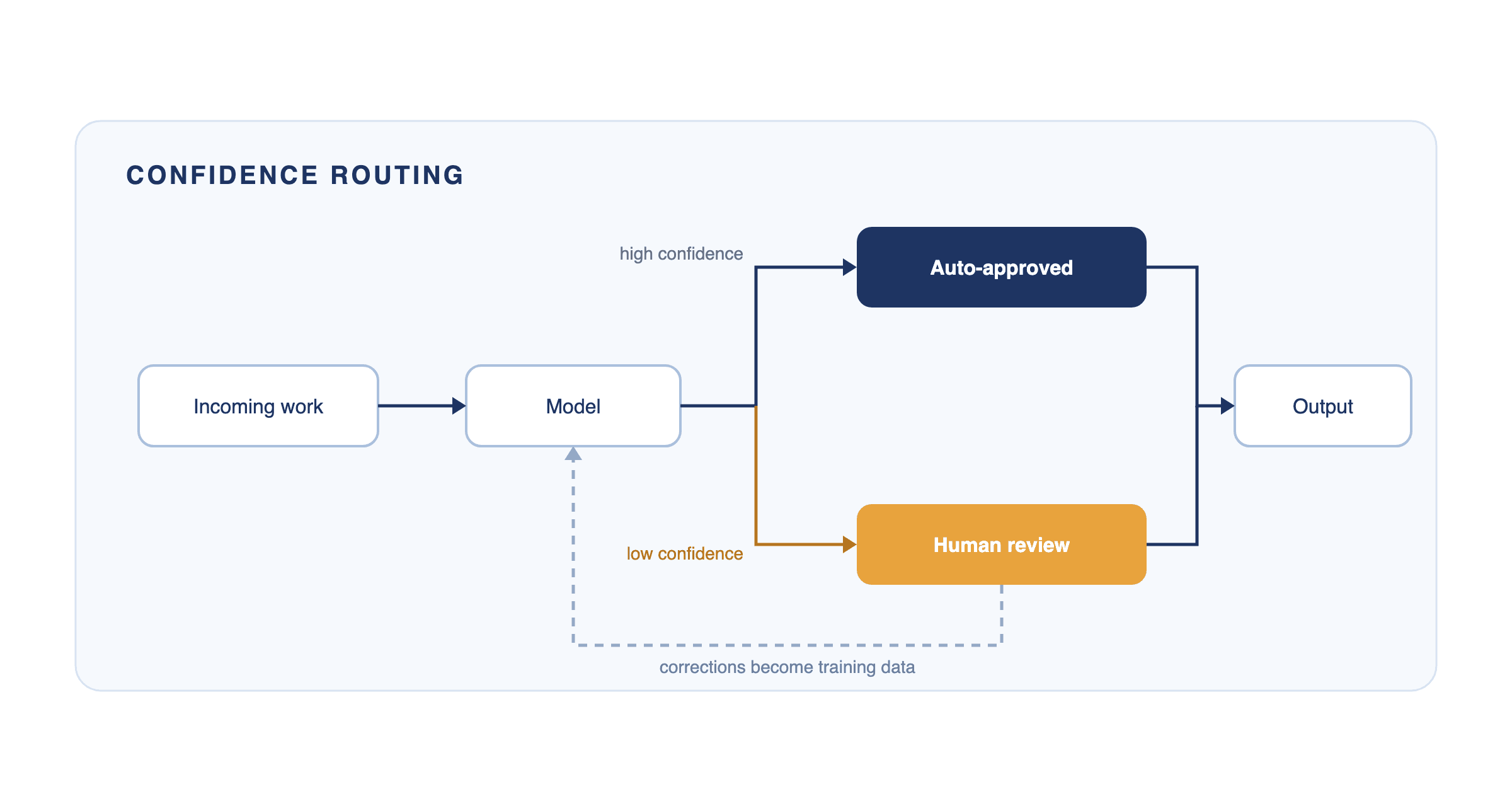
Every incoming item goes to the model. The model produces a result and a confidence signal. Above a threshold, the result flows straight through. Below it, the item goes to a human queue.
The economics are what make this compelling:
- If 85% of items clear the threshold, you've eliminated 85% of the manual work
- The 15% needing review are exactly the ones a person should have looked at anyway
- Your error rate on auto-approved items is far below the model's overall rate, because you removed the hard cases
- The threshold is a dial. Regulatory pressure, an incident, a new document type, turn it up and more goes to humans. Confidence grows, turn it down.
That last property matters more than anything else here. A fully autonomous system has one setting. A confidence-routed system has a control you can adjust without redeploying, and that's what lets you launch cautiously and expand safely.
On confidence signals: getting a genuinely calibrated one takes work. Raw model scores are often overconfident. Practical approaches include checking agreement across multiple runs, validating outputs against business rules (does this invoice total actually equal the line items?), cross-checking against existing records, and simply routing anything unusual (an unseen vendor, an out-of-range value) regardless of what the model says. In practice a combination beats any single signal, and business-rule validation is usually the highest-value one because it's deterministic and explainable.
Where the human goes
Three placements, and they solve different problems.
Before, human sets up the work. A person handles intake, resolves ambiguity, and hands the model a clean task. Useful when inputs are messy and the model's failure mode is misunderstanding what it was asked.
During, human reviews before it counts. The confidence-routing pattern above. This is the default and the one that fits most processes.
After, human audits a sample. Everything flows through automatically, and a person reviews a random sample plus anything flagged. Appropriate for genuinely low-stakes, high-volume work where per-item review can't be justified, but only when errors are recoverable, because by the time you find one it has already had effect.
Most systems should start during and consider moving to after once the data justifies it. Going the other way (starting fully automatic and adding review after something goes wrong) means the incident is your learning mechanism.
The part that decides success: the review interface
This is where these projects actually live or die, and it gets a fraction of the attention the model does.
If reviewing an item takes as long as doing it from scratch, you've saved nothing. If the interface makes approving easier than scrutinising, reviewers will approve everything and your safety net is theatre.
What a good review interface does:
Shows the source alongside the output. The reviewer must verify against the original without leaving the screen or opening another system. If they have to hunt for the source document, they'll stop checking.
Highlights what to look at. Don't present a form of twelve equally-weighted fields. Show which fields are uncertain and why. Attention is the scarce resource; spend it where the risk is.
Makes correcting fast. Inline editing, keyboard navigation, sensible defaults. If fixing one field takes six clicks, throughput collapses.
Makes rejecting as easy as accepting. If approve is a big button and reject is buried, you've designed a rubber stamp. This is the single most common design failure in these systems.
Captures why something was wrong. Not just the correction, the reason. This is what turns review into training data instead of just cleanup.
Shows the reviewer their own impact. You corrected 40 items this month; the model improved 3% on this field. Reviewing is tedious, and people do it better when they can see it accomplishing something.
Design this with the people who'll use it eight hours a day. A review interface designed by engineers who'll never use it is reliably bad in ways that are obvious to anyone who does.
Automation bias, and how to fight it
People trust computer output more than they should. Show someone a pre-filled answer and they will approve it at a far higher rate than if asked to produce it themselves. This is well documented, it's not a failing of your staff, and it will happen to your team.
The result is a review step that looks like a control and functions as a formality.
What actually helps:
Measure the override rate. If reviewers change fewer than a few percent of items, something is wrong, either your threshold is too conservative and you're wasting their time on easy cases, or they've stopped reading. Both need fixing, and you can't tell which without asking.
Seed known-wrong items. Occasionally inject an item with a deliberate error and see whether it's caught. This measures whether review is real. Be transparent with the team that you do this, it's a system check, not a trap, and framing it as a trap poisons the whole thing.
Don't pre-fill the highest-stakes field. For the one decision that matters most, make the human commit before showing the model's answer. Then show it and let them reconsider. Slower, and it preserves independent judgement where it counts.
Watch for fatigue. Accuracy degrades over long review sessions. Cap queue length, rotate people, and don't measure reviewers on throughput alone, you'll get exactly what you measure.
Closing the loop
Every correction is a labelled example: the input, the model's answer, the right answer, and ideally why. This is the highest-quality training data you will ever get, produced as a by-product of running the system.
Most teams throw it away. They store the corrected value and discard the fact that a correction happened.
Capture the full record, original output, correction, reviewer, timestamp, reason. Then actually use it:
- Find patterns. If 60% of corrections are one field on one document type, that's a specific fixable problem, not a vague quality issue.
- Build your evaluation set. Corrections are real production failures, a far better test set than anything assembled by hand.
- Retrain or refine prompts against them.
- Track drift. A rising correction rate is your earliest warning that something changed upstream. This is often the first signal that a vendor altered a document format.
A system with this loop gets better every month. One without it is as good on day 500 as day 1, and quietly worse, because the world moved.
When to remove the human
Legitimately sometimes. The bar:
- Sustained measured accuracy on the auto-approved band, over months, not a good week
- Errors are recoverable and someone will notice within a useful window
- The cost of an error is genuinely low: arithmetic, not assertion
- You keep sampling. Never go to zero oversight. Audit a percentage forever.
Even then, keep the routing infrastructure. Turning the threshold back up should be a config change, not a project. The day a vendor changes their invoice template, you'll want that dial.
Reduce oversight where volume is high and stakes are low. Keep it where a single error is expensive. Most businesses end up with different thresholds for different categories, which is exactly right.
What to measure
Automation rate: share handled without review. This is your ROI. Accuracy on auto-approved items: measured by sampling. The number that matters most, and the one usually not measured. Override rate: how often reviewers change things. Your check on whether review is real. Time per review: determines whether the economics work. Correction patterns: where errors cluster, driving your roadmap.
Note that overall model accuracy isn't on this list. It's the least useful number, because it averages over cases you handle differently.
The summary
For most Indian businesses deploying AI, the target isn't a system that does the whole job. It's one that does the easy 80% invisibly and routes the hard 20% to someone competent, with a fast review interface, an honest confidence signal, and a feedback loop that turns corrections into improvement.
That's less exciting than full autonomy and it's what actually works. It also fails gracefully, when a confidence-routed system encounters something it doesn't understand, a human sees it. When an autonomous one does, a customer does.
If you're still deciding whether to build anything at all, start with the ROI check, filter two there is essentially this article's argument in shorter form.
Building something like this?
We design and build human-in-the-loop AI systems for Indian businesses (document processing, classification, triage, extraction) including the review interfaces and feedback loops that decide whether they work. We'd rather build you a system with an honest 85% automation rate that runs for years than a 100% claim that gets switched off after an incident.
Bengaluru-based, working with clients across India and globally.
Get in touch · See our AI work · WhatsApp: +91 9677749648