If you're a non-technical founder hiring your first engineers, you're in a genuinely difficult position: you're evaluating a skill you don't have, from candidates who know you can't evaluate it.
That asymmetry is why non-technical founders get burned. Not because they're careless, because the normal tools of hiring don't work. You can't read the code. You can't tell whether we used microservices with Kubernetes was good judgement or résumé-building. You can't tell whether six months of slow progress is a hard problem or a weak engineer.
This is workable. It requires different methods than you'd use for a sales or marketing hire.
The first hire decides the rest
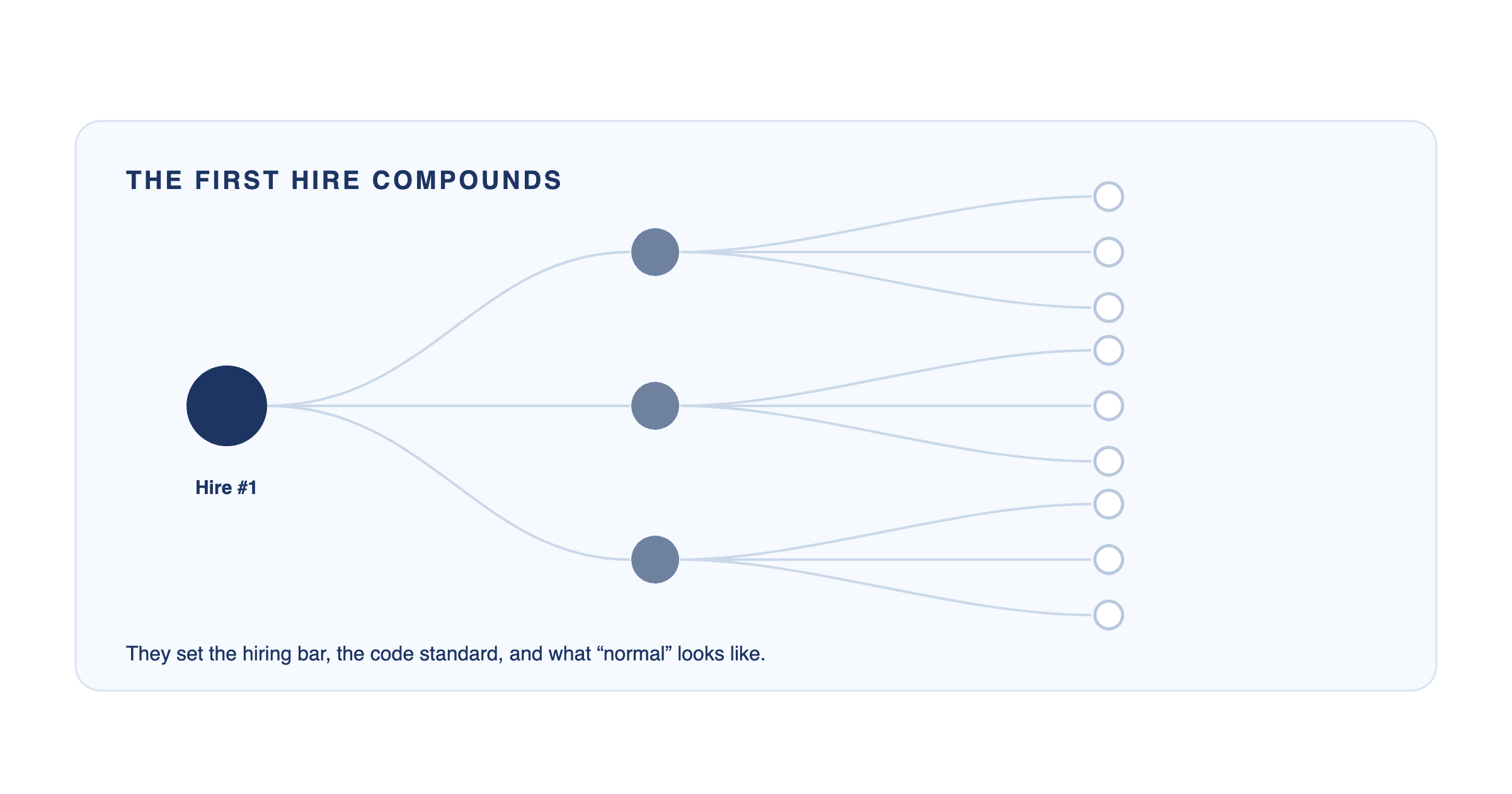
Your first engineer doesn't just write code. They set the technical direction, define what good looks like, and, most importantly, interview everyone who comes after.
Hire a strong first engineer and they raise the bar. They'll reject candidates they consider weak, and your team compounds upward.
Hire a weak one and something worse than bad code happens: they hire people they aren't threatened by. Standards drift down, and by the time you can see the problem you have a team, a codebase, and no internal ability to fix either.
So spend disproportionate effort here. It's reasonable to take three months on your first engineering hire and three weeks on your third.
Get the role right first
Founders routinely advertise the wrong job.
CTO usually isn't what you need.** A CTO sets technical strategy, manages engineers, and owns architecture at scale. At pre-product stage, you need someone who builds the thing. Advertising CTO attracts people who want to manage, and you'll end up with a manager and nobody to manage.
Hire a senior engineer who can own delivery. If they grow into a CTO as the company grows, excellent, that's the good path. Handing the title on day one costs you equity and leverage for a job that doesn't exist yet.
Be honest about seniority. A junior is not a cheaper senior. Without someone experienced to learn from, a junior will make architectural mistakes nobody catches for a year. For a first hire with no technical oversight, junior is a false economy.
Decide whether you need a specialist. Full-stack developer is fine for most products. If you're building something genuinely specialised (real-time systems, embedded, heavy data engineering) you need that specialisation, and generalists will struggle in ways you won't detect for months.
Employee, freelancer, agency, or fractional CTO
Four routes, and the honest trade-offs:
Full-time employee. Best long-term. Full commitment, accumulating context, aligned incentives. Also slowest to hire, in India, notice periods of 60 to 90 days are standard, so a hire made today may start in three months. Budget for that gap; founders are consistently surprised by it.
Freelancer. Fast and flexible, good for defined pieces of work. The risk is continuity, freelancers leave, and when they do, undocumented knowledge leaves too. Fine for a well-specified component, risky for your core product.
Agency. Buys you a team and process immediately, with senior oversight built in. More expensive per hour, and the code eventually needs to come in-house. The right choice when you need to move now and don't yet know what team to build. (We're an agency, so weigh that, but the honest version is that agencies suit a defined build, not an indefinite one.)
Fractional CTO. An experienced person a day or two a week to set direction, review work, and, critically, help you hire and evaluate engineers. This is the highest-leverage option for a non-technical founder and the most underused. It directly addresses your actual problem, which is that you can't evaluate technical work.
A pattern that works well: fractional CTO for oversight, plus one or two full-time engineers they help you select. You get senior judgement without a senior salary, and someone in your corner during hiring.
How to evaluate when you can't evaluate
Use a paid work sample
The single most effective thing you can do.
Give a real, small, self-contained piece of work, a day or two, paid at their rate. Not a puzzle, not an algorithm quiz. Something resembling what they'd actually do.
Then look at what you can assess without reading the code:
- Did they ask clarifying questions? Strong engineers surface ambiguity before building. Someone who takes a vague brief and silently builds something is showing you how they'll behave for the next two years.
- Did they deliver what was discussed? Or something adjacent and more interesting to them?
- Did they finish? Working and complete beats elegant and half-done.
- Can they explain their choices in plain language? This is the best proxy you have. Genuine understanding survives translation into non-technical terms. Someone who can only explain it in jargon either doesn't understand it or can't communicate. Both are disqualifying for a first hire.
- How did they handle feedback? Ask for a change. Defensive is a signal.
Pay for it. Unpaid multi-day exercises drive away the strongest candidates, who have options.
Get a technical read
Have someone technical you trust review the work sample. Options: a fractional CTO, a technical advisor, an engineer friend at another company, or a paid technical interviewer.
Do this even if it costs money. A few hours of a senior engineer's time is trivial against a mis-hire that costs six months and a codebase.
If you genuinely have nobody, ask the candidate to walk you through their code and explain each decision. You're not evaluating the code, you're evaluating whether the explanations are coherent, consistent and honest, including I'm not sure, I'd need to test that.
Reference checks that actually work
Most references are useless because the questions invite politeness. These work better:
- What did they need the most support with? Everyone has something. Nothing means the reference isn't being straight.
- Would you hire them again, into what role? Hesitation is the answer.
- How did they handle it when something they built didn't work? You learn about ownership.
- Who else should I speak to? Off-list references are more candid.
Push past the first pleasant answer. Silence works, people fill it.
Red flags specific to the Indian market
Notice period ambiguity. Standard notice is 60 to 90 days. A candidate promising to join in two weeks is either buying out their notice (fine, confirm it), or planning to abscond (a real practice, and it tells you how they'll treat your notice period too).
Résumé inflation on team size and scope. Led a team of 15 and architected the platform are worth probing gently: what did you personally build, what decisions were yours, what would you do differently? Inflation collapses quickly under specific questions, and the collapse itself is informative.
Offer shopping and ghosting after acceptance. Common in competitive segments. A candidate may accept and continue interviewing, then not appear on day one. Mitigations: keep engaged between offer and joining, be a place people actually want to work, and always have a second candidate warm. Don't stop your pipeline the day someone accepts.
Undisclosed parallel employment. Ask directly, write it into the contract, and be clear about expectations. Handle it as a contractual matter rather than a moral one.
Certification stacking. Long lists of certifications with thin delivery history. Certifications demonstrate course completion, not the ability to ship. Weight the work sample far higher.
None of these mean the Indian talent market is bad, it's deep and excellent. They're the specific failure modes to design your process around.
What actually attracts good engineers
If you're competing with funded startups and global companies paying in dollars, salary alone won't win. What does:
Interesting problems. Genuinely the strongest draw for the best people. Real ownership. Owning a whole area beats being one of forty on a platform team. A founder who respects engineering. Engineers can tell within one conversation whether you see them as partners or as a cost centre. This is more visible than founders realise. Not being jerked around. Fast, respectful, well-organised hiring signals how you'll operate as an employer. Honesty about stage and risk. Overselling stability to someone who'll discover the truth in month two guarantees an early exit.
On compensation: research current market rates for your city, stack and seniority before making offers, the market moves fast enough that any number printed in an article is stale. Underpaying your first engineer is the most expensive saving available to you.
The first ninety days
Hiring well and then onboarding badly wastes the hire.
Give them something shippable in week one. Small, real, deployed. It builds momentum and shows you how they work.
Set outcome expectations, not activity expectations. You cannot evaluate how they spend Tuesday. You can evaluate whether the thing works and arrived roughly when promised.
Establish a written weekly rhythm. What shipped, what's next, what's blocked. Written, so there's a record and so you can spot drift early.
Insist on documentation from day one. For a non-technical founder this is protection. If your only engineer leaves and nothing is written down, you're in serious trouble. Deployment steps, credentials handling, architecture notes, decisions and why. Make it a normal expectation, not an accusation.
Get access to everything. Servers, repositories, domains, cloud accounts, in your company's name, with you as owner. Not the engineer's personal account. This is the most common and most damaging mistake we see: founders discovering their infrastructure sits in a departing employee's personal account. Fix it on day one, framed as ordinary business hygiene, because that's what it is.
The summary
You're hiring for a skill you can't directly assess, so change what you assess: use a paid work sample, judge communication and judgement rather than code, get a technical read from someone you trust, and check references properly.
Spend disproportionate effort on the first hire, because they choose everyone after. Consider a fractional CTO, it solves your actual problem more directly than anything else on the list.
And get the account ownership right on day one. It costs nothing now and it's the thing founders most often wish they'd done.
If you're also scoping the build itself, Your MVP Is Probably Too Big covers how much you actually need to build first.
Need technical help you can trust?
We work with non-technical founders in India, as a build team, as fractional CTO support, and as a technical read on candidates you're considering. Including telling you honestly when hiring in-house beats hiring us.
Bengaluru-based, working with clients across India and globally.
Get in touch · CTO advisory · WhatsApp: +91 9677749648