We've shipped production apps in both. Here's the conclusion up front, because most comparisons bury it under a feature table:
Both are good. Both will build your app. For the large majority of projects, either choice succeeds, and the one that fails does so for reasons unrelated to the framework.
The interesting question isn't which is better. It's which is better for your team, your hiring market, and the specific app you're building. That's a genuinely different question, and it has a real answer.
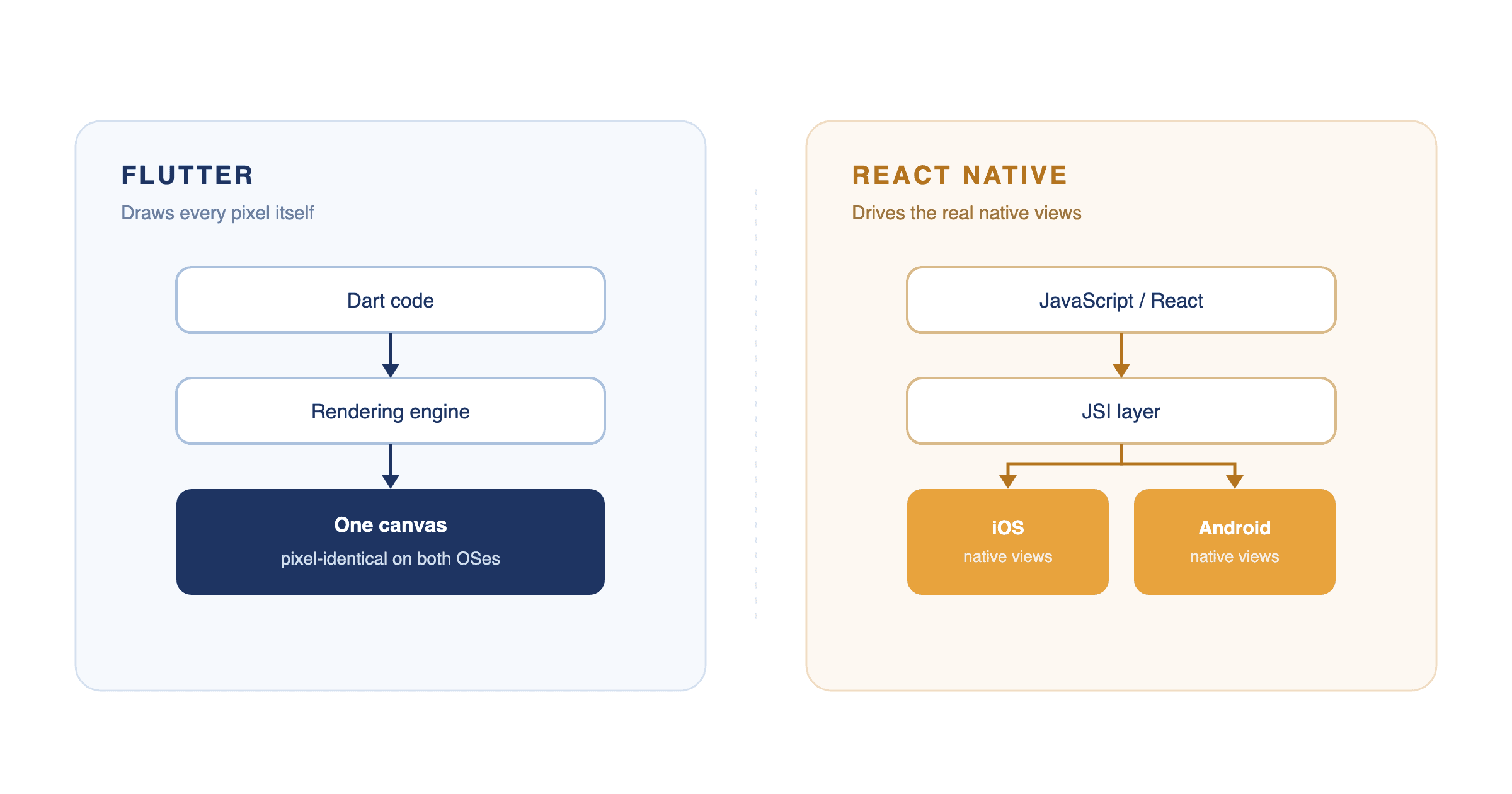
The one technical difference that matters
Everything else follows from this.
Flutter draws its own pixels. It ships a rendering engine and paints every control onto a canvas. A Flutter button is not an iOS button, it's a drawing of one. The app looks identical on both platforms because it's the same drawing code.
React Native drives the real native views. Your JavaScript describes a UI, and the framework instantiates actual UIView and Android View objects. A React Native button is a native button.
The consequences:
Flutter gives you pixel-perfect consistency. Your design renders identically everywhere. Nothing shifts because an OS updated its widget styling. If you have a strong custom design system, this is a real advantage, you implement it once and it's correct on both platforms.
React Native gives you platform-native behaviour for free. Scroll physics, text selection, accessibility, keyboard handling, and the dozens of small interactions users feel without being able to name. When iOS changes something, you inherit it. Flutter has to reimplement it, and there's usually a lag.
Flutter carries a larger binary. You're shipping a rendering engine. It's a meaningful difference on a base app, though it matters less as apps grow.
React Native's boundary is a source of complexity. The JS-to-native boundary has improved enormously, the modern architecture replaced the old asynchronous bridge with a direct synchronous interface, but it's still a boundary, and it's still where the hard bugs live.
Performance: mostly a non-issue
This dominates online debate and decides almost nothing.
For the overwhelming majority of apps (content, commerce, booking, social, dashboards, forms, business tools) both frameworks are comfortably fast enough. Users cannot tell. If your app feels slow, the cause is almost certainly your network layer, your image handling, or an over-rendering list, not your framework.
Where a real difference appears:
- Heavy custom animation and graphics. Flutter's direct rendering control is an advantage.
- Very long, complex lists. Both are fine when done properly; both are terrible when done badly. Implementation quality dominates.
- Startup time. Both have overhead. Neither matches true native.
- Sustained computation on device. Video processing, on-device ML, large data transforms. Both hand this to native code, so the comparison is about how pleasant that handoff is, not about the framework's own speed.
If you're building a real-time game or a video editor, neither is the right tool. Go native, or use an engine built for it.
The factor that actually decides it in India: hiring
This is the argument most comparisons skip, and in the Indian market it usually outweighs everything else.
JavaScript and React developers are abundant. Every bootcamp produces them, every web team already has them, and the pool is enormous. If you're hiring in Bengaluru, Chennai or Hyderabad, you'll fill a React Native role faster and from a deeper pool.
Dart developers are scarce as a hiring category: but this is less limiting than it sounds. Dart is a conventional, easy language for anyone from Java, C# or TypeScript, and competent engineers become productive in it within a couple of weeks. You're hiring a good engineer who'll learn Dart, which is a wider pool than a Flutter developer.
So the honest version:
- You already have a React or web team → React Native is the obvious answer. They'll be productive immediately, share tooling and patterns, and possibly share code with your web app.
- You're hiring from scratch and need people fast → React Native has the shallower hiring curve.
- You have a strong engineering team without JS attachment → Flutter is very pleasant to work in, and the scarcity argument mostly disappears.
- You're a solo founder or two-person team → pick whichever you already know. Learning curve costs more than any framework difference.
Where each genuinely wins
Choose Flutter when
You have a strong custom design system. If your brand demands a distinctive look rather than platform-standard controls, Flutter is built for that. You're already overriding native styling, so native widgets buy you nothing.
You need identical rendering across platforms. Regulated, diagram-heavy, or precision-layout apps where it looks slightly different on Android is a real problem.
You're targeting beyond phones. Embedded displays, kiosks, point-of-sale terminals, in-vehicle screens. Flutter's self-contained rendering makes it genuinely portable in a way React Native isn't.
You want fewer platform-specific surprises. Because Flutter controls rendering, works on iOS, broken on Android happens noticeably less.
Choose React Native when
You have a React web app and want to share code. Business logic, validation, API clients, state management, types. This is the single strongest argument for React Native and it's decisive when it applies.
Platform-native feel is a requirement. Apps that should feel like they belong to the OS rather than expressing a brand.
You need deep native integration. Not because Flutter can't do it, but because the ecosystem of existing native modules for React Native is larger, so you're more likely to find the bridge already written.
Over-the-air updates matter to you. Pushing JavaScript changes without an app store review is a mature, well-supported workflow in the React Native ecosystem, a genuine operational advantage for fixing bugs quickly. Equivalents exist for Flutter but are less established.
What actually goes wrong (in both)
Framework choice is rarely the cause of failure. These are:
The native module gap. Some SDK you need (a payment provider, a specific hardware integration, a regional service) has no maintained plugin. Now you're writing native code on both platforms, which is exactly the work you adopted cross-platform to avoid. Check your critical third-party SDKs before choosing. In India this bites hardest on payment SDKs, KYC providers, and hardware peripherals.
The upgrade treadmill. Both frameworks move fast, and so do iOS and Android. Skipping upgrades for a year turns a routine update into an archaeology project, usually because a transitive dependency was abandoned. Budget a maintenance day per month from the start. Teams that don't, pay for it in a painful quarter later.
Assuming one codebase means half the work. It doesn't. You still test on both platforms, handle two sets of permissions, manage two store submissions, and fix platform-specific bugs. Realistically you save perhaps 30 to 40% versus two native apps, substantial, but not the 50% the pitch implies.
Hiring for the framework instead of for engineering. A strong engineer learns your framework in weeks. A weak one writes bad code in the framework they already know. This mistake costs far more than picking wrong.
When you shouldn't use either
Games and heavy real-time graphics. Use a game engine.
The app is fundamentally one platform. If 95% of users are on iOS and you have no plans otherwise, native Swift is simpler, faster, and better supported. Cross-platform's value is proportional to how much you actually need both.
Deep, continuous OS integration. Widgets, complex background processing, tight hardware access, and anything living close to the OS. Possible in both frameworks, but you'll be writing native code for the hard parts anyway.
A simple content app that could be a website. The most common expensive mistake. If your app is mostly displaying content, a good responsive web app may serve you better, no store review, instant updates, no install friction. Build the app when you need what only an app provides.
How we'd actually decide
Five questions, in order:
- Do you have an existing React/web team or codebase? Yes → React Native. This alone usually settles it.
- Is there a critical third-party SDK with support on only one framework? That constraint wins over every preference.
- Is your UI heavily custom-branded, or platform-standard? Heavily custom → Flutter. Platform-standard → React Native.
- Are you targeting anything beyond phones? Kiosks, embedded, POS → Flutter.
- Which can you hire for, in your city, at your budget? If it's still tied, this breaks it, usually toward React Native in India.
If you reach question five with no clear answer, pick either and start building. The time spent deciding is worth more than the difference.
The thing that actually matters more
Whichever you choose, the decisions that determine whether your app succeeds are mostly framework-agnostic: how you handle offline state, how you manage API errors on bad networks, how you structure navigation, how you handle authentication and token refresh, whether you have crash reporting and analytics from day one.
We've seen excellent apps in both frameworks and terrible ones in both. The correlation with framework choice is approximately zero. The correlation with whether the team thought carefully about state management and error handling is very high.
For more on scoping the build itself, see Your MVP Is Probably Too Big.
Building a mobile app?
We build production mobile apps in both Flutter and React Native, and we'll tell you honestly which fits your team, including when the answer is native, or when you don't need an app at all.
Bengaluru-based, working with clients across India and globally.
Get in touch · See our mobile work · WhatsApp: +91 9677749648