Marketing is where most businesses deploy their first AI agent, for an obvious reason: the work is repetitive, text-heavy, and the tooling is easy to buy.
It's also where the failures are most public. A support agent's mistake is seen by one customer. A marketing agent's mistake is seen by everyone, screenshotted, and outlives the campaign.
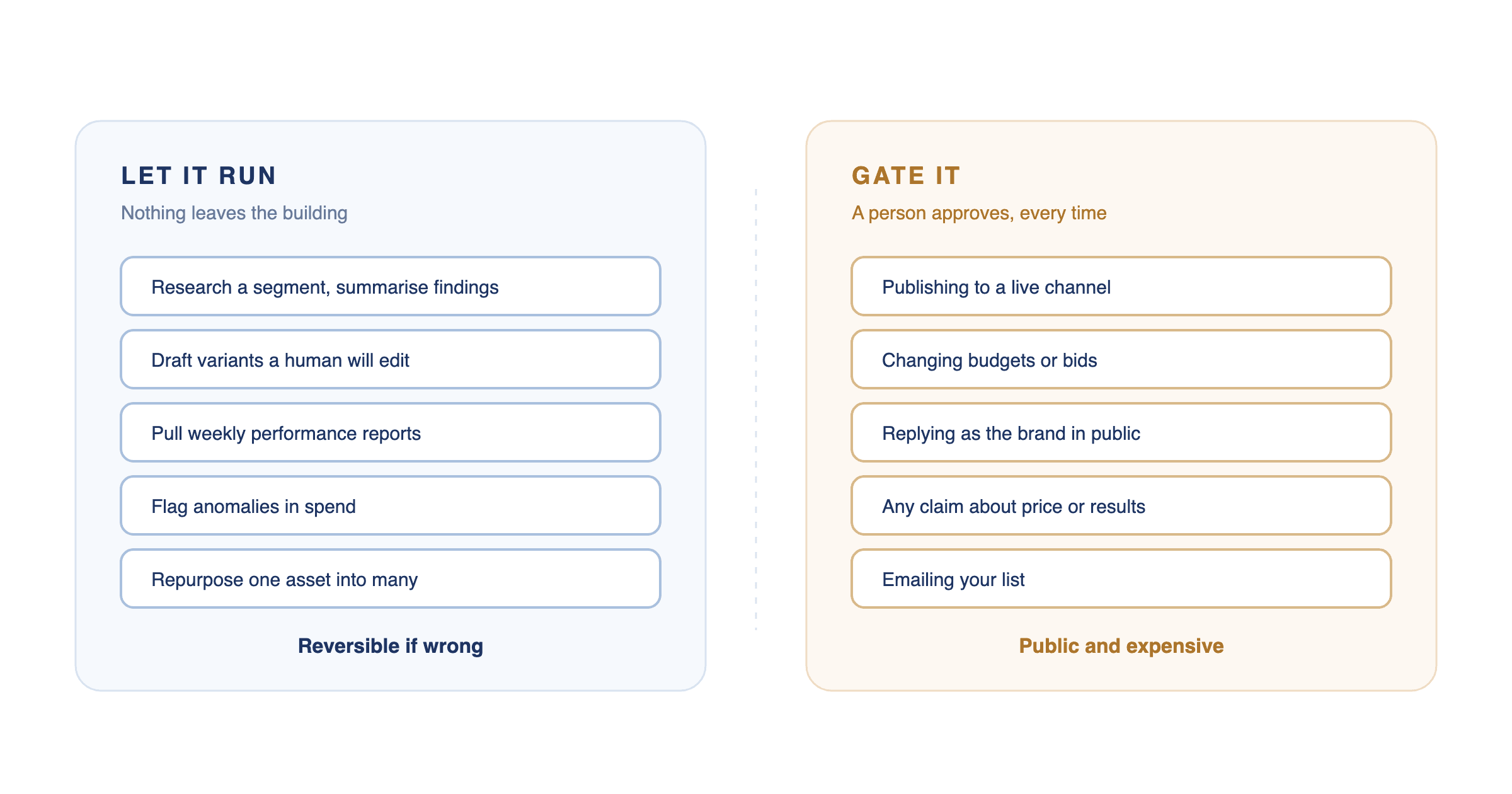
The line between the two is simple enough to state in one sentence: an agent can do anything that stays inside your building, and needs a human on anything that leaves it. Everything below is the practical version of that.
Let it run: work that stays internal
These are genuinely good agent tasks. High volume, low stakes, and a person sees the output before anyone else does.
Research and synthesis. Reading competitor sites, summarising a category, pulling together what customers in a segment complain about. Hours of work, and being 90% right is fine because a human is reading it as input to a decision, not publishing it.
First drafts. Ad variants, subject lines, product descriptions, social copy. The agent produces twenty options, a marketer keeps two and rewrites one. This is the highest-value use in marketing and it's the least discussed, because AI writes drafts a human edits doesn't make a good demo.
Repurposing. One long asset into a dozen shorter ones, an article into social posts, a webinar into clips with descriptions, a case study into an email sequence. Mechanical, tedious, and something agents genuinely do well.
Reporting. Pulling numbers from ad platforms, analytics and your CRM into a weekly summary, with the notable changes called out. Marketers lose hours a week to this, and the agent's output goes to an internal audience who can sanity-check it.
Anomaly flagging. Spend spiking on one campaign, conversion rate dropping on one landing page, a keyword's cost per acquisition doubling. The agent watches and tells someone. It doesn't act.
Enrichment and routing. Taking an inbound lead, finding public information about the company, scoring it against your criteria, routing it to the right person. Being wrong means a lead goes to the wrong salesperson, which is recoverable.
Gate it: anything public or expensive
Each of these needs a person to approve before it happens. Not a review afterwards, approval before.
Publishing to any live channel. Social, blog, anywhere with your name on it. The failure mode isn't bad grammar; it's tone-deaf timing, a claim you can't support, or something that reads fine in isolation and terribly next to the news that morning. An agent has no idea what happened in the world today.
Changing budgets or bids. An agent with write access to your ad accounts can spend a month's budget in an afternoon through a logic error. If you automate bid adjustments, cap them: maximum change per adjustment, maximum daily spend, and a hard ceiling the agent cannot exceed. Treat this exactly like giving an intern your company card.
Replying as the brand in public. Comments, reviews, social replies. A wrong or robotic reply to an angry customer, in public, is the classic screenshot. Draft-and-approve is fine; autonomous is not.
Any claim about price, results or availability. This is where marketing crosses into legal exposure. An agent that invents a discount, overstates a result, or promises a delivery time creates a commitment you may have to honour. Advertising claims in India are regulated, and the AI wrote it is not a defence.
Emailing your list. Deliverability is fragile and hard to recover. A bad automated send damages sender reputation for months.
The thing that gets missed: brand voice degrades quietly
Generic AI marketing copy is recognisable, and the recognition is getting sharper. Audiences are developing a reliable ear for it.
The damage isn't a single bad post. It's that six months of competent, characterless output makes your brand sound like everyone else's, which is precisely the opposite of what marketing is for.
Two things help. Keep a real style guide with examples, including things you'd never say, and put it in the prompt. And make sure a human is genuinely editing rather than approving. If your marketer's job has become clicking approve on agent output, you have automated the production of forgettable content at scale.
The businesses getting the most from this use agents to increase the volume of options a good marketer chooses from, not to replace the choosing.
Guardrails worth building
A claims allow-list. Statements about pricing, results, guarantees or comparisons that the agent may make, and nothing outside it. Everything else gets flagged for a human.
A banned-topics list. Competitors by name, politics, religion, anything currently sensitive. Cheap to implement, saves a bad week.
Spend caps in the platform, not the prompt. A prompt saying don't spend more than ₹5,000 a day is a suggestion. An API-level cap is a control. Use the control.
Full logging. What the agent drafted, who approved it, when it went out. When something does go wrong you need to reconstruct it quickly, and the agent decided to is not an acceptable answer to a regulator or a client.
A kill switch someone knows how to use. Test it. An automation nobody can stop at 9pm on a Friday is a liability.
What to measure
Time saved per week, per marketer, on the specific tasks you automated. If nobody can name what they now do instead, you've added a tool rather than capacity.
Edit distance on drafts. How much of the agent's output survives to publication? Very low means the drafts aren't useful; very high means nobody is really editing, and that's the brand-voice problem forming.
Approval throughput. If approvals are backing up, the agent is generating faster than humans can review, and quality will slip.
Performance versus human-only baseline. Keep some campaigns fully human. If agent-assisted work performs worse, you want to find that in a comparison rather than in a quarterly decline.
Where it doesn't pay
- Small content volume. If you publish twice a month, agent tooling costs more attention than it saves.
- Highly technical or regulated content. Where every claim needs expert review, drafting isn't the bottleneck, review is.
- No style guide and no brand voice. The agent will produce the average of the internet, which is exactly what you don't want.
- Nobody to review. Without review capacity, you'll drift into publishing unreviewed output, which is the failure mode this whole article is about.
The honest summary
Agents are genuinely useful in marketing, and the useful part is unglamorous: research, drafts, repurposing, reporting, flagging. Internal work, reviewed by a person, at higher volume than a human could produce alone.
The part being sold (autonomous campaigns that write, publish and optimise themselves) is where the public failures come from, and the upside doesn't justify it. Marketing output carries your name, and the cost of one bad post is not symmetrical with the saving from a hundred automated ones.
Keep the human on everything that leaves the building. That single rule prevents nearly every failure in this article.
The human-in-the-loop pattern is the general form of this, and the four filters will tell you whether your content volume justifies starting at all.
Thinking about AI in your marketing?
We build agent workflows for Indian businesses, including the approval gates, spend caps and logging that keep them out of trouble. We'll also tell you when your volume doesn't justify it, which for smaller marketing teams is often the honest answer.
Bengaluru-based, working with clients across India and globally.
Get in touch · See our agentic AI work · WhatsApp: +91 9677749648