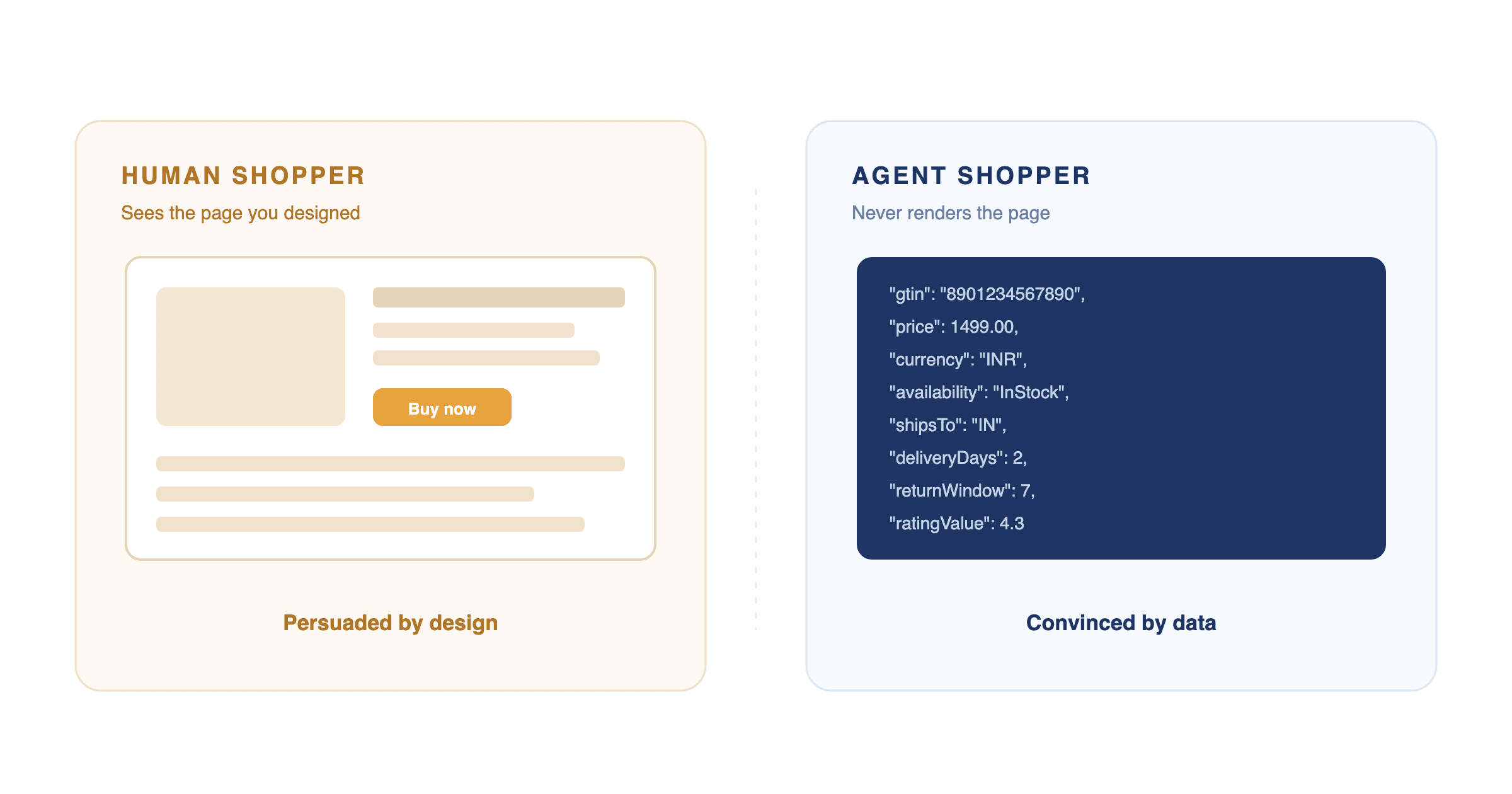
There's a version of this topic that's pure speculation. AI does all our shopping, retail transformed, act now. Ignore that.
There's also a concrete, near-term shift that's worth preparing for, and it's narrower than the hype: a growing share of the traffic evaluating your products will never render your page.
That's already true for price comparison, for marketplace feeds, and increasingly for people asking an assistant find me a 5-star rated water purifier under ₹15,000 that ships to Coimbatore in two days. Whether that becomes 5% or 50% of discovery, the preparation is the same, and most of it is work you should be doing anyway.
Here's the practical version for Indian sellers.
The core shift: persuasion stops, data starts
Your product page is built to persuade a human. Photography, layout, social proof, urgency, a well-designed buy button. All of it depends on a person looking at it.
An agent doesn't look. It reads whatever structured information it can extract, compares against alternatives on attributes it can parse, and either shortlists you or doesn't. Your hero image, your copy and your button design are invisible to it.
So the questions change:
- Is your price machine-readable, or rendered inside an image, or only visible after a variant is selected?
- Is availability accurate and exposed? In stock that turns out to be false is a failure an agent will never forgive, and if it's ordering on someone's behalf, that failure is expensive.
- Are your specifications structured, or buried in a paragraph of marketing prose?
- Do you have a stable product identifier. GTIN, EAN, MPN, that lets an agent know your listing and a marketplace listing are the same product?
- Are delivery time and serviceability by pincode exposed, or discoverable only at checkout?
Those five determine whether an agent can consider you at all. Most Indian ecommerce sites currently fail at least two.
What to actually do, in order
1. Structured product data
Mark up your product pages with proper schema: Product, Offer, AggregateRating, Review. Price, currency, availability, condition, shipping, return policy, all as structured fields rather than prose.
This is not new advice and it isn't speculative: it's the same markup that drives rich results in search today. The difference is that it stops being a nice-to-have for click-through rate and becomes the entire basis on which you're evaluated. If you do one thing from this article, do this.
Accuracy matters more than completeness. Structured data that says in stock when you're out is worse than omitting the field.
2. Real product identifiers
GTIN or EAN where they exist, consistent MPNs where they don't. Without a stable identifier, an agent can't confidently match your listing to the same product elsewhere, and unmatched products drop out of comparisons.
This is unglamorous catalogue hygiene and it's a genuine competitive gap in Indian ecommerce, where a lot of catalogues have inconsistent or missing identifiers.
3. Pincode-level serviceability, exposed
This is the India-specific one, and it's a real advantage if you get it right.
Delivery in India is pincode-dependent in a way that most global guidance doesn't account for. A shopper (human or agent) filtering for delivers to 641001 in two days needs that answer without going through checkout. If serviceability is only computable at the last step, you're invisible to any comparison that includes delivery, which is most of them.
Expose it. An endpoint that answers can you deliver SKU X to pincode Y, and in how many days is genuinely useful, and few of your competitors have one.
4. Return and warranty terms as data
Easy returns means nothing to an agent. returnWindow: 7, returnFees: 0, warrantyMonths: 12 means something. These are exactly the attributes agents weight when comparing similar products at similar prices, and they're where a better seller can win against a cheaper one.
5. An API, if you sell B2B
For B2B, the shift is further along and more concrete. If your buyers' procurement systems can query your catalogue, check stock and place an order programmatically, you get designed into their workflow. If they have to log into a portal and type, you're friction, and friction is what agents are deployed to remove.
What doesn't change
Worth saying plainly, because there's a lot of noise suggesting otherwise:
Brand still matters. Agents weight ratings, reviews and returns data heavily. Those are downstream of actually being good. A well-structured listing for a bad product loses to a well-structured listing for a good one.
Price isn't everything. In-stock, fast delivery to the right pincode, and a good return window regularly beat a lower price with worse terms, because an agent optimising for arrives by Friday doesn't care that you're ₹40 cheaper if you can't.
Humans are still the majority. Don't degrade the human experience to court agents. Structured data is invisible to humans; it costs your design nothing.
The uncomfortable part: agents will also read your reviews
If your ratings are mediocre, agents will surface that more consistently than a human skimming a page would. A person might buy despite a 3.4 rating because the photos looked good. An agent filtering for 4+ stars simply excludes you.
That's a real consequence. The advantage shifts toward sellers who are genuinely good and away from those winning on presentation.
What we'd tell you not to do yet
Don't build an in-house shopping agent for your own customers unless you have a specific, high-volume repeat-purchase use case. For most Indian retailers this is a solution looking for a problem, and the effort is better spent making your catalogue machine-readable.
Don't restructure your site around agent traffic. You're preparing for a channel, not migrating to one.
**Don't buy an agentic commerce platform to solve what is, at this stage, a structured-data and catalogue-quality problem. The work is unglamorous data hygiene, and vendors selling something more exciting are selling something you don't need yet.
Don't block agents wholesale in robots.txt without thinking it through. There's a legitimate debate about scraping, but blanket-blocking assistant crawlers means being absent from the comparisons they generate. Decide deliberately rather than by default.
The honest summary
Agentic commerce isn't something to bet the business on this year. But the preparation is genuinely low-risk, because everything on the list improves your conventional SEO and your human conversion rate too.
Structured product data, real identifiers, exposed pincode serviceability, machine-readable return terms, accurate stock. That's a catalogue-quality project with immediate benefits and a free option on a channel that may become significant.
If it doesn't, you've cleaned up your product data and improved your search presence. That's a good outcome either way, which is exactly the kind of AI-adjacent work worth doing, per the four filters.
Selling online in India?
We work on ecommerce and catalogue systems for Indian businesses, structured data, pincode serviceability, product identifier hygiene, and the B2B ordering APIs that get you designed into your buyers' procurement. Mostly unglamorous work that pays off in search today and in agent discovery later.
Bengaluru-based, working with clients across India and globally.
Get in touch · See our agentic AI work · WhatsApp: +91 9677749648