Over the last week a lot of people have asked some version of the same question: the AI bubble is bursting in China, so should we slow down our own AI work?
It is a fair question and it deserves a straight answer rather than a headline. The short version is that something real happened, it is not the thing most of the coverage says it is, and only one of its consequences should change what you do this quarter.
What actually happened
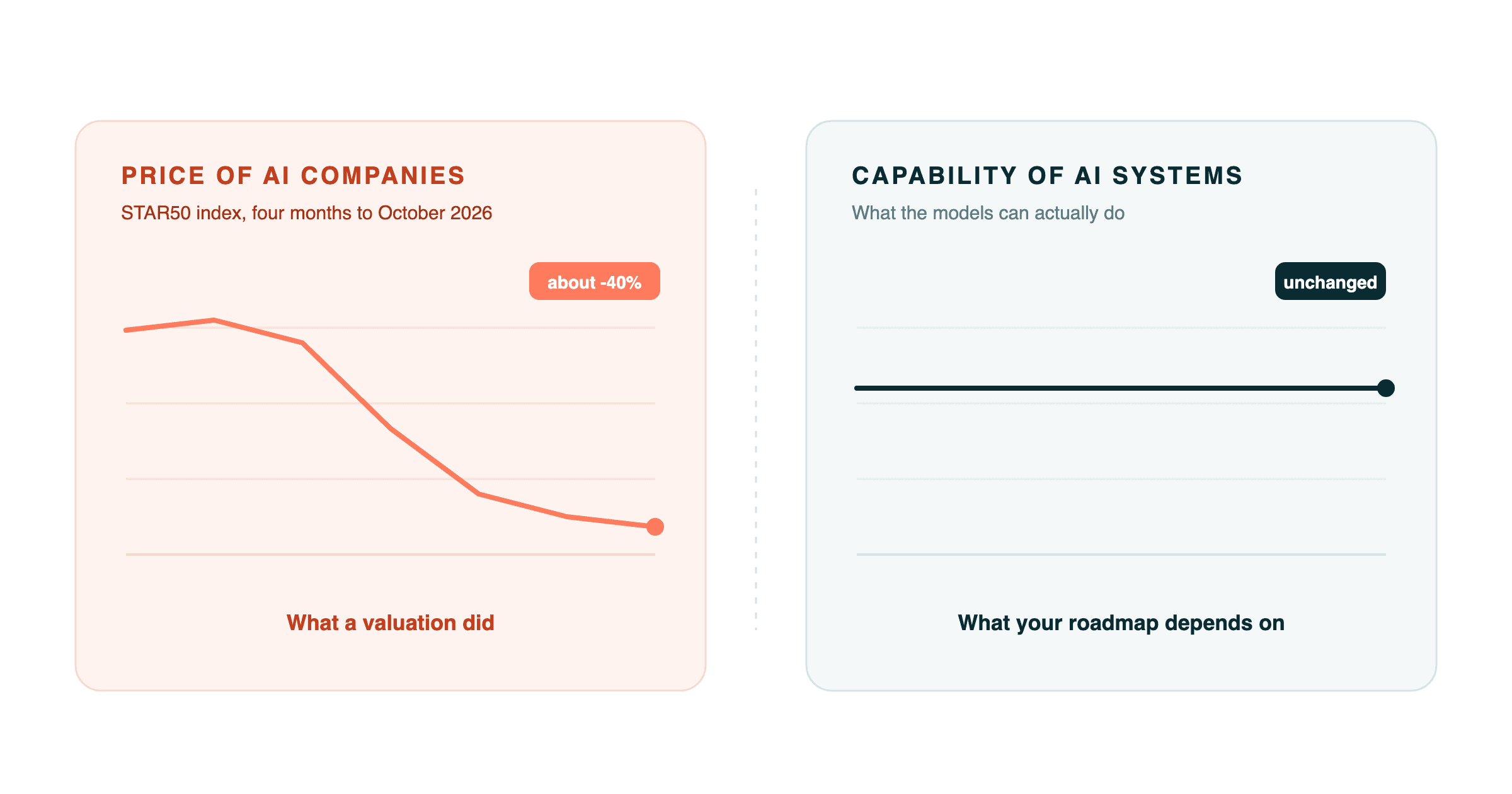
China's STAR50 index tracks the country's largest listed chip and AI companies. Reuters reported on 26 October that it has fallen roughly 40% in under four months, wiping out something in the region of 480 billion dollars of market value. The broader blue chip index is down about 20% from its high.
Two details matter more than the headline number.
The first is where it fell from. At the peak the index was trading near 250 times trailing earnings. After a 40% fall it is still around 100 times. For comparison, the Nasdaq 100 sits near 30. A 40% drop from 250 times earnings is not a collapse in the underlying business. It is a valuation that was priced for a decade of perfection giving some of that back.
The second is that Reuters found no single trigger. There was no failed product, no earnings miss, no regulatory decision on the day. Commentary since has pointed at stretched multiples, export restrictions, corporate tax deadlines and softer demand signals. When there is no trigger and no news, the honest reading is that the price was the story, not the technology.
A caution on the numbers. We could only reach the Reuters analysis through secondary coverage, and a lot of what is circulating is derivative reporting that re-states the same figures with progressively more confident framing. The 40% and the 480 billion dollars appear consistently. Sources disagree on whether the rally peaked in June or July. Treat the timeline as approximate and do not build an argument on the precise date.
The thing that is real, and older than this week
Underneath the market story there is a genuine structural problem, and it has been visible since 2025.
China built an enormous amount of datacentre capacity very quickly, a lot of it in central, western and rural areas where land and electricity are cheap. MIT Technology Review reported in March 2025 that hundreds of these facilities were barely running. One local estimate put as much as 80% of recently built capacity as idle. That 80% figure comes from local reporting and has not been independently verified, so hold it loosely, but the direction is not in dispute. Operators have been cancelling projects and trying to resell GPUs.
The reason is instructive, and it is an architecture problem rather than a finance one. Cheap power and cheap land are not what AI training workloads optimise for. They need dense power delivery, serious cooling, and above all low latency interconnect to the rest of the stack. A warehouse of GPUs a long way from everything else is not a substitute for a facility built for the job. The country ended up with a glut of the wrong kind of capacity alongside a shortage of the right kind.
It is worth putting the counter-evidence next to it. SemiAnalysis estimates that combined capital expenditure at ByteDance, Alibaba, Tencent and Baidu went from roughly 35 billion dollars in 2024 to over 50 billion in 2025, on a path towards 100 billion in 2026. GDS management has suggested another eighteen months to fully digest the price reset. That is a market absorbing a bad build cycle, not one walking away.
So: a real glut of poorly specified capacity, being worked off slowly, while spending by the serious players keeps rising. That is a messy picture. It is not a burst.
What did not change
Nothing about what the models can do changed between June and October. No capability was withdrawn. The systems your competitors are running today work exactly as well as they did before the selloff.
This is the distinction worth holding onto, because it is the one the coverage keeps collapsing. The price of AI companies and the usefulness of AI systems are two different quantities. They have been correlated for three years, which makes it easy to forget they are not the same thing. Railway companies went bankrupt in the 1840s and the railways stayed. The same pattern has repeated often enough that it should be the default assumption rather than a surprise.
If you were planning to automate a document workflow in January, a Shanghai valuation multiple is not information about whether that workflow is worth automating.
The four decisions worth revisiting
Here is where the news should actually touch your plans.
Do not sign long compute commitments right now. If the glut is real and still being digested, the direction of compute pricing over the next year or so is down, not up. Reserved instance and committed spend contracts are priced off today's expectations. A three year commitment signed in a soft market is the one decision here that is genuinely hard to reverse. Shorter terms cost a little more per unit and buy you the option to re-price. Take the option.
Check your vendor concentration honestly. Not the slide that says multi cloud. The actual question is: if your primary model provider doubled its prices or had a bad quarter, how many weeks of work is it to move? For most teams we audit the answer is far worse than they assume, because provider specific features leak into application code long before anyone notices. A thin interface between your product and whichever model answers the call is cheap to build on day one and expensive to retrofit.
Separate your experiments from your production path. The failure mode in a wobbly market is not that AI stops working, it is that a vendor you built on gets acquired, repriced or quietly deprecates the endpoint you depend on. Experiments can sit on anything. Anything in your production path deserves a named fallback and an honest estimate of how long switching takes.
Price your workloads on today's rates, not last year's. If you built a cost model when compute was tight, rerun it. This is the one piece of genuinely good news in the story: for a buyer, a supply glut is cheap input prices. Several things that did not justify themselves eighteen months ago may clear the bar now. That cuts both ways, and the way it cuts for you is favourable.
What would actually worry us
To be clear about what would change our view, since a position that nothing can falsify is not worth much:
- Capability plateauing across several independent labs at once, rather than valuations falling
- The large spenders cutting capital expenditure rather than merely slowing its growth
- Enterprise renewal rates dropping, which is demand, as against share prices, which are expectations about demand
- Inference costs rising sustainably instead of falling
None of those is happening at the moment. The thing that is happening is that a set of extremely expensive stocks became somewhat less expensive.
What we tell clients
If you are mid-build, carry on. If you are planning a build, this is a slightly better moment to buy compute than last quarter, not a worse one.
The one change worth making is structural rather than strategic. Build so that switching providers is a configuration change and not a project. That advice was correct before the selloff and it will be correct after whatever comes next. The value of it just went up, because the probability of needing it did.
The genuinely bad outcome here is not a bubble. It is a team that pauses useful work for two quarters because of a share price in another country, and then spends those two quarters watching a competitor ship.
If you want a second opinion on where your AI and cloud spend actually goes, and what it would take to make your stack portable, that is the sort of thing our cost audit is for. Two weeks, fixed scope, and a written answer either way.