Almost every founder who asks us about WhatsApp opens with the same question: How much does the WhatsApp API cost?
It's the wrong first question, and answering it directly usually leads people to a bad decision. The API itself costs nothing. What you pay for is the messages you send, and separately (often invisibly) for whoever sits between you and Meta.
Get the second part wrong and you'll pay a markup for years on a layer you didn't need. Get it right and WhatsApp becomes the cheapest high-engagement channel available to an Indian business.
Here's how the pieces actually fit together.
First: there is no WhatsApp API company
This trips up more people than anything else. WhatsApp Business Platform is Meta's product. There is exactly one source of truth, and it's Meta.
Everyone else. Gupshup, AiSensy, Interakt, Wati, Twilio, 360dialog, and the dozens of Indian resellers advertising WhatsApp API from ₹999/month, is a Business Solution Provider (BSP). They are resellers with tooling built on top of Meta's platform. They are not an alternative to it.
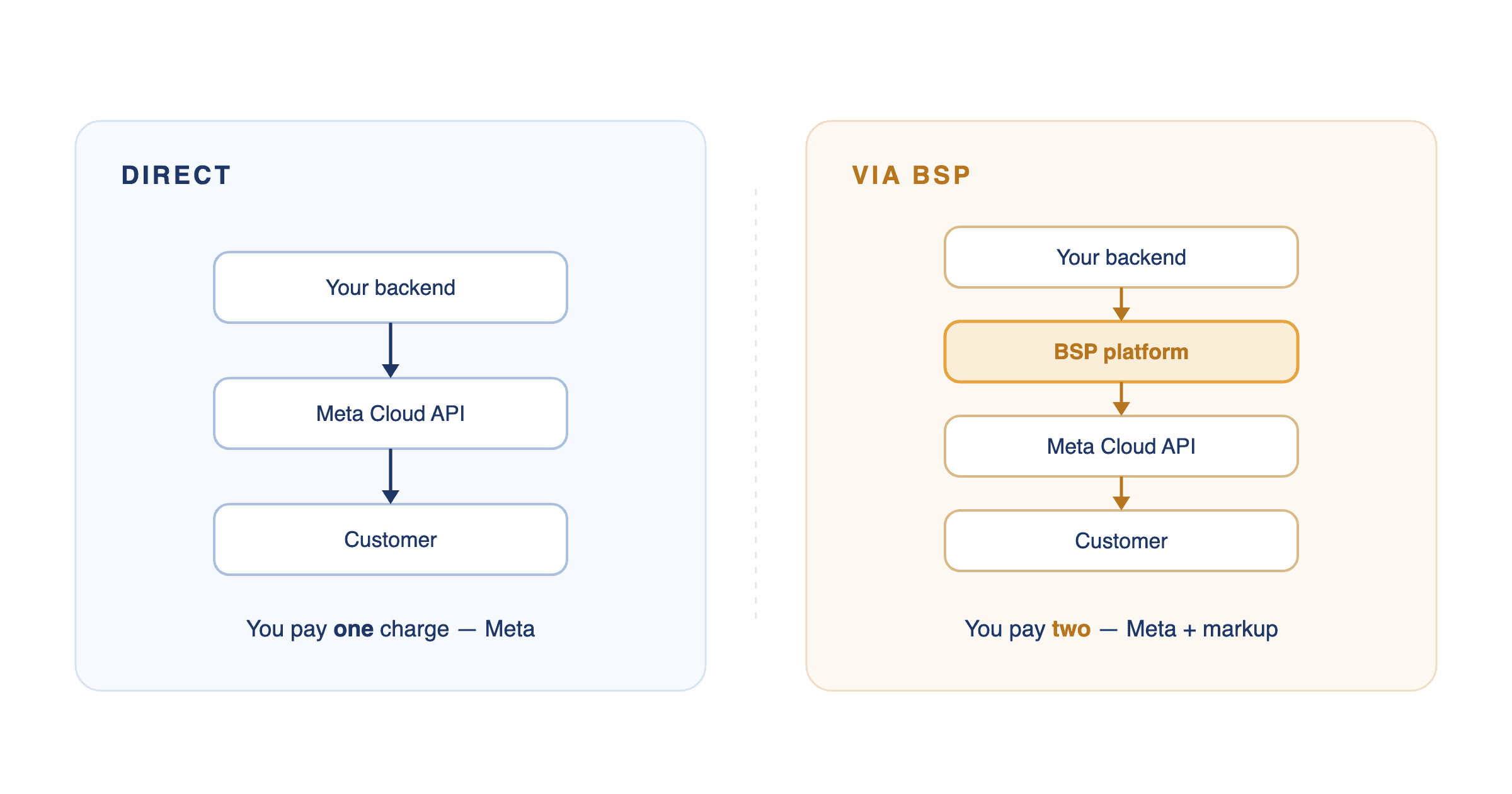
So the question isn't which WhatsApp API should I buy. It's do I go to Meta directly, or through a BSP? Two routes, same underlying platform.
Route 1. Cloud API, direct from Meta
Meta hosts the API. You get an endpoint, a phone number ID, and an access token. You send an HTTP POST to send a message, and you receive a webhook when something arrives.
What you pay: Meta's per-message charge, and nothing else. Meta does not charge for API access or hosting.
What you get: a raw API. No dashboard, no shared team inbox, no campaign scheduler, no chatbot builder, no analytics, no contact management. If you want any of that, you build it.
Who it suits: teams with engineering capacity who are embedding WhatsApp inside a product, order updates from your own backend, OTPs, delivery notifications, support tickets flowing into a system you already run. If WhatsApp is a feature of your software, direct is almost always right.
There used to be an On-Premises API you hosted yourself. Meta has retired it in favour of Cloud API. Ignore any guide that tells you to self-host, it's out of date, and building on a sunset product is a migration you're scheduling for yourself.
Route 2, through a BSP
A BSP sits between you and Meta. They handle onboarding, and they layer a product on top: a team inbox, broadcast campaigns, drip sequences, a no-code bot builder, CRM integrations, analytics, and often a WhatsApp catalogue and payments hookup.
What you pay: Meta's per-message charge, plus the BSP's markup, their platform fee, or both. Pricing models vary a lot: some add a percentage per message, some charge a flat monthly platform fee, some do both, and some quote a bundled per message rate with their cut already folded in so you never see Meta's actual number.
What you get: speed and non-technical usability. Your marketing team can run a campaign without filing a ticket with engineering.
Who it suits: businesses where WhatsApp is a channel operated by humans, sales teams working leads, support agents handling conversations, marketers running broadcasts. If the people using WhatsApp all day aren't engineers, a BSP earns its money.
The pricing model, and why your bill is never just one number
Meta charges per message, and the rate depends on the template category and the destination country. India is one of the cheaper markets, which is exactly why WhatsApp works so well here.
The categories:
- Marketing: promotions, offers, re-engagement. The most expensive, and the most restricted.
- Utility: order confirmations, shipping updates, payment receipts, appointment reminders. Substantially cheaper than marketing.
- Authentication. OTPs and login codes. Priced separately.
- Service: your replies inside a conversation the customer started.
Two structural facts matter far more than the exact rates:
Customer-initiated service conversations are free. When a customer messages you first, you have a 24-hour window to reply with free-form messages at no per-message charge. This is the single biggest cost lever in the whole system, and most businesses ignore it. A support flow designed so customers open the conversation costs a fraction of one where you open it.
Utility is much cheaper than marketing. The same notification can fall into either category depending on how you word the template. Your order #4821 has shipped, track it here is utility. Your order shipped, and here's 20% off your next one is marketing, and Meta will recategorise it. Businesses routinely pay marketing rates for what should have been utility messages, purely through template wording.
Verify current rates before you build a business case. Meta's rate card changes (the pricing model itself was restructured in 2025) and BSP markups change more often. Pull the live India rates from Meta's official pricing page and get your BSP's markup in writing, per category, before you commit to volume projections.
Choosing: five questions
1. Who touches WhatsApp day to day? Engineers and automated systems → direct. Sales, support, or marketing staff → BSP. This one question decides it more often than the other four combined.
2. Do you need a shared inbox? Multiple agents handling one number, with assignment and history, is genuinely hard to build. If you need it, you're buying a BSP or spending months building one.
3. What's your monthly message volume? BSP markup is a percentage or per-message fee. At low volume the markup is trivial and the tooling is free leverage. At high volume the markup becomes the dominant line item, and building directly starts paying for itself. Run the arithmetic at your projected 12-month volume, not today's.
4. Is WhatsApp inside your product, or beside it? Order updates fired by your backend belong on the direct API. Conversations a human runs belong on a BSP.
5. Can you tolerate an intermediary in the data path? Every message routes through the BSP's infrastructure. For fintech, healthcare, or anything under DPDP scrutiny, that's a data-processing relationship needing a real agreement, not just a checkbox.
There's a legitimate hybrid: direct Cloud API for transactional traffic from your backend, and a BSP on a second number for the sales team. Two numbers, two routes, each doing what it's good at.
What actually blocks your launch
Pricing is what people research. These are what actually delay them by weeks.
Meta Business Verification
Your business must be verified in Meta Business Manager. You'll need registration documents, a verifiable business address, and a phone number and website that match your documents.
This is the single most common source of delay. Rejections are frequently about mismatched details, a slightly different legal name, an address that doesn't match your GST registration, a website with no visible contact information. Fix the paperwork before you apply, not after a rejection.
Start this first. It runs in parallel with everything else, and everything else waits on it.
The phone number rules
The number you use for the API cannot be active on the regular WhatsApp app or the WhatsApp Business app. It must be either a fresh number or one you deliberately migrate off the app, which deletes its existing chat history.
Businesses lose real conversation history this way. If your sales team has been running WhatsApp Business on a number for two years, migrating it wipes those threads. Plan for it, usually the right answer is a fresh number for the API and letting the old one wind down.
The number also needs to receive an SMS or voice OTP during setup, so it must be live and reachable.
Template approval
Every message you send outside a customer-initiated 24-hour window must use a pre-approved template. You submit the text with variable placeholders, and Meta reviews it.
Rejections are common and the feedback is terse. What gets rejected:
- Anything that reads as promotional but was filed as utility
- Placeholder abuse, a template that's almost entirely variables, so Meta can't tell what it actually says
- Missing context, where the message doesn't make sense without knowing what the variables contain
- URL shorteners, which look like cloaking
Build a template library early and get it approved before you're depending on it for a launch. Approvals aren't instant and a rejection right before go-live is a bad week.
Quality rating and messaging tiers
You don't get unlimited sending on day one. You start in a tier limiting how many unique customers you can message in 24 hours, and you move up as you send successfully.
Your quality rating is driven by how recipients react. Blocks and report taps drive it down. Drop far enough and your tier is cut or your number is restricted.
This is the part that punishes bad marketing. Buy a contact list, blast it, and you will get blocked at scale and lose your number's standing. WhatsApp is not email, the tolerance for spam is far lower and the penalty lands on your infrastructure, not just your open rate.
The green tick is separate
The green checkmark is an Official Business Account, and it's a different thing from business verification. It's granted at Meta's discretion based on brand notability. Most businesses don't get it, most don't need it, and no BSP can guarantee it. Treat anyone who promises one as a red flag about everything else they've told you.
A realistic setup sequence
- Start Meta Business Verification. Longest pole. Begin immediately.
- Decide direct vs BSP using the five questions, while verification runs.
- Choose and provision the phone number. Fresh number unless you have a strong reason, and confirm it can receive an OTP.
- Connect the number to Cloud API or your BSP, and complete the OTP step.
- Write and submit templates. Categorise honestly. Submit more than you think you need, approval takes time and rejections need rework.
- Wire webhooks. Inbound messages and delivery status. Verify your webhook endpoint responds correctly to Meta's challenge, and that it's idempotent, retries happen.
- Test with real handsets. Behaviour differs between Android and iOS, and between WhatsApp and WhatsApp Business, especially for interactive buttons and list messages.
- Warm up sending. Start with engaged customers who expect to hear from you. Build quality rating before you scale volume, not during.
Budget three to six weeks end to end, dominated by verification and template approval. The engineering is the fast part, a working send-and-receive integration is a few days' work.
Four mistakes that cost real money
Sending to a purchased list. It will destroy your quality rating within days and can cost you the number. There is no volume of leads worth this.
Filing marketing as utility. Meta recategorises it, you get flagged, and repeat offences hurt your standing. Write utility templates that are genuinely utility, no offers, no upsell.
Designing flows that always start with you. Every business-initiated conversation is billable. Every customer-initiated one gives you a free 24-hour window. A reply STOP to opt out, or reply HELP for support pattern turns billable outbound into free inbound. Design for it deliberately.
Locking into a BSP with no export path. Ask before you sign: can you export contacts, conversation history, and templates? Can the number be transferred to another BSP or to direct Cloud API? Some make leaving genuinely painful. The answer should be in writing.
Where this usually lands
For most Indian businesses we work with, the split is straightforward: if WhatsApp is how your software talks to customers, go direct to Cloud API and keep the margin. If WhatsApp is how your people talk to customers, pay for a BSP and let your team move without engineering in the loop.
The expensive mistake is paying BSP markup on high-volume automated traffic that your backend was always going to send by itself.
Need this built properly?
We integrate WhatsApp Business API for Indian businesses, direct Cloud API, BSP integrations, and the hybrid setups where transactional and human traffic are split across numbers. Including the parts nobody warns you about: verification paperwork, template strategy, and flows designed so you're not paying for conversations you could have had for free.
Bengaluru-based, working with clients across India and globally.
Get in touch · See our API integration work · WhatsApp: +91 9677749648