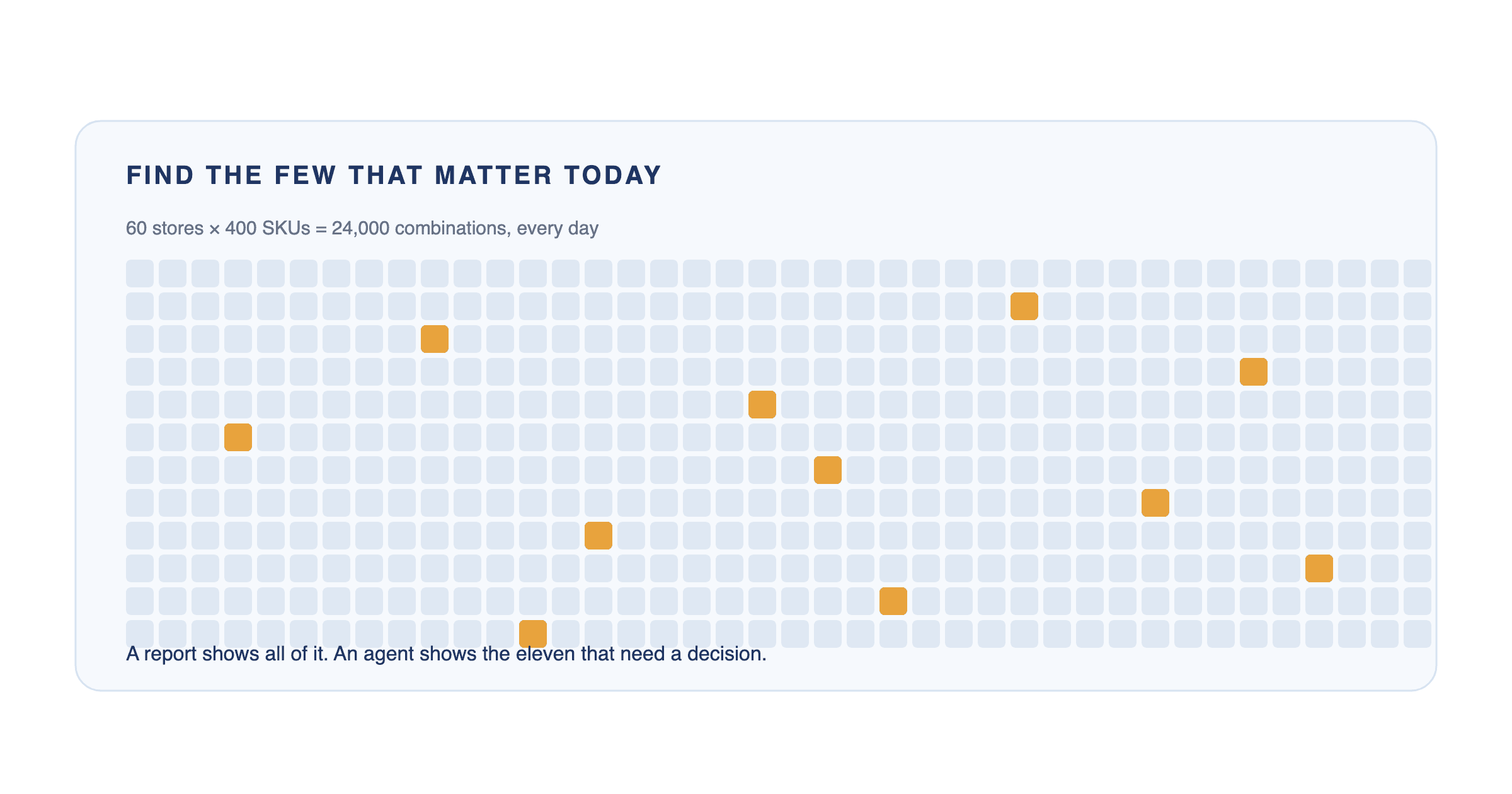
Retail and supply chain have a structural property that makes them unusually good for agents: the decisions are numerous, repetitive, and mostly boring, but a small fraction of them matter a great deal.
Sixty stores and four hundred SKUs is 24,000 store-product combinations. Every day, each one either needs action or doesn't. No human reviews that. So businesses do what's tractable instead, a weekly report someone skims, and a reorder policy that's the same for everything.
The result is predictable: you're overstocked on slow movers and stocked out on the things people came in for. Both are expensive, and neither shows up clearly in a monthly P&L.
This is what agents are actually good at. But the highest-value applications are not the ones businesses ask for first.
Start here: exception detection
The single most valuable agent in retail is one that reads everything daily and tells you the small number of things that need a decision today.
Not a dashboard. Not a report. A short list, with reasoning:
- Store 14 will stock out of the top-selling SKU in three days at current rate
- Store 7's shrinkage on one category is double the chain average this week
- This supplier's last four deliveries were late; two more POs are open with them
- This SKU hasn't moved in 60 days across 12 stores and is tying up working capital
- Store 22's return rate on one product tripled, possibly a damaged batch
Each is knowable from data you already have. None of them gets noticed reliably, because noticing requires someone to look at 24,000 combinations.
This works because the agent isn't predicting anything. It's applying consistent rules and statistical comparison across a volume no person can cover, then explaining what it found. Being occasionally wrong is cheap, someone checks and dismisses it.
Most businesses should build this and nothing else for the first year.
Then: replenishment recommendations, with a human deciding
The obvious next step, and the one that needs care.
An agent proposes order quantities per store per SKU, accounting for current stock, sales velocity, lead time, minimum order quantity, shelf life and known upcoming events. A person reviews and approves, in bulk, quickly, with the unusual ones highlighted.
Recommend, don't order. Automatic ordering fails badly in Indian retail for reasons that have nothing to do with the model: a festival date that moved, a local event, a road closure, a competitor's promotion, a supplier who says yes and delivers 60%. Your category manager knows these things and your data doesn't.
The realistic win is the review taking twenty minutes instead of a day, with better coverage of the long tail. That's substantial. Full autonomy is a much smaller additional gain for a much larger risk.
The India-specific factors that break imported playbooks
Festival demand is not a seasonal curve. Diwali, Onam, Pongal, Eid, Durga Puja, they move against the Gregorian calendar, they differ by region, and the demand shape differs by category. A model trained on last year's dates without festival awareness will be confidently wrong at the worst possible time. Encode the festival calendar explicitly. This is the most common failure we see in imported forecasting tools.
Regional variation within one chain. A national chain's Chennai stores and Delhi stores behave differently enough that one model for both underperforms two simpler regional ones.
Supplier reliability varies enormously. A supplier who delivers 60% of the order 40% of the time needs different safety stock than one who is consistently on time. Most systems assume a fixed lead time. Model reliability, not just duration, it's often the biggest single lever on stockouts.
Distribution is layered. Distributor, sub-distributor, retailer. Your visibility often stops at the first hop, and the agent can only reason about what it can see. Be honest about where your data ends.
Weather and local events matter more than the models assume, particularly for food, beverages and anything seasonal.
Where else agents genuinely help
Supplier communication. Chasing POs, confirming dispatch, following up on short deliveries. Enormous volume of routine messages, mostly on WhatsApp and email in Indian supply chains. An agent that drafts, chases and escalates saves real hours.
Goods receipt reconciliation. What was ordered versus what arrived versus what was invoiced. Three-way matching at volume, with the agent resolving small explainable differences and escalating the rest. This is the workflow agent pattern applied to a specific problem, and it's reliable.
Planogram and availability checks. Photos from stores checked against what should be on shelf. Genuinely useful for chains where audits are infrequent.
Returns triage. Classifying returns by reason, spotting patterns that indicate a batch problem rather than customer preference.
Cold chain monitoring. Where you already have IoT sensors, an agent that watches excursions, judges severity and escalates appropriately. This pairs directly with predictive maintenance and the ROI is easy to calculate because spoiled stock has a known value.
What to be cautious about
Demand forecasting as your first project. This is what most businesses ask for and it's the hardest thing on the list. It needs clean history, festival awareness, promotion data, and honesty about accuracy. A forecast that's 70% accurate can still be useful, but only if the business understands what 70% means and doesn't plan as though it's certain. Start with exception detection; you'll build the data foundation forecasting needs anyway.
Dynamic pricing. Technically straightforward, commercially risky. Customers notice, competitors react, and in some categories there are regulatory considerations. If you do it, cap the range tightly and log every change.
Autonomous supplier ordering. Committing money to a supplier without human approval is the highest-risk automation in this list, and the payoff is small next to recommend-and-approve.
The data reality check
Before any of this, four honest questions:
Is your stock data accurate? Not does the system have a number, is the number right? If physical counts diverge from system stock by 10%, every recommendation inherits that error. Fix inventory accuracy first; it's unglamorous and it's the foundation.
How current is it? Daily is workable. Weekly batch means the agent is always reasoning about a world that has moved.
Do you have clean sales history? Two years is comfortable. One is workable. Six months means you'll miss the festival cycle entirely.
Are promotions recorded? If a sales spike was caused by a discount and nothing records the discount, the agent learns that demand randomly tripled that week. This one quietly ruins more forecasting projects than any modelling choice.
What to measure
Stockout rate on your top SKUs. The number that connects most directly to lost revenue.
Working capital in inventory, especially slow-moving stock. The other side of the same coin.
Recommendation acceptance rate. How often the category manager accepts the agent's proposal unchanged. Low means it isn't trusted; very high means nobody is really reviewing.
Time spent on replenishment. Hours per week, before and after.
Exceptions acted upon. Of the things it flagged, how many led to action? If it's low, the thresholds are wrong and people will stop reading.
The honest summary
In Indian retail and supply chain, the agent worth building first is the one that reads everything every day and hands you a short list of things worth deciding about. It needs no forecasting, no autonomy, and no perfect data, just consistent rules applied at a volume humans can't cover.
Replenishment recommendations come second, with a person approving. Forecasting comes later, once the data foundation is real.
The businesses that get value here are the ones that fixed inventory accuracy first and started with exceptions. The ones that start with a demand forecasting model on unreliable stock data get a number nobody trusts and a project nobody defends.
Running stores, warehouses or a distribution network?
We build retail and supply chain agents for Indian businesses, exception detection, replenishment recommendations, three-way matching, supplier follow-up, cold chain monitoring. Starting with an honest look at whether your stock data can support it.
Bengaluru-based, working with clients across India and globally.
Get in touch · See our agentic AI work · WhatsApp: +91 9677749648